Case Study
GPConnect: Navigating Healthcare
Project overview
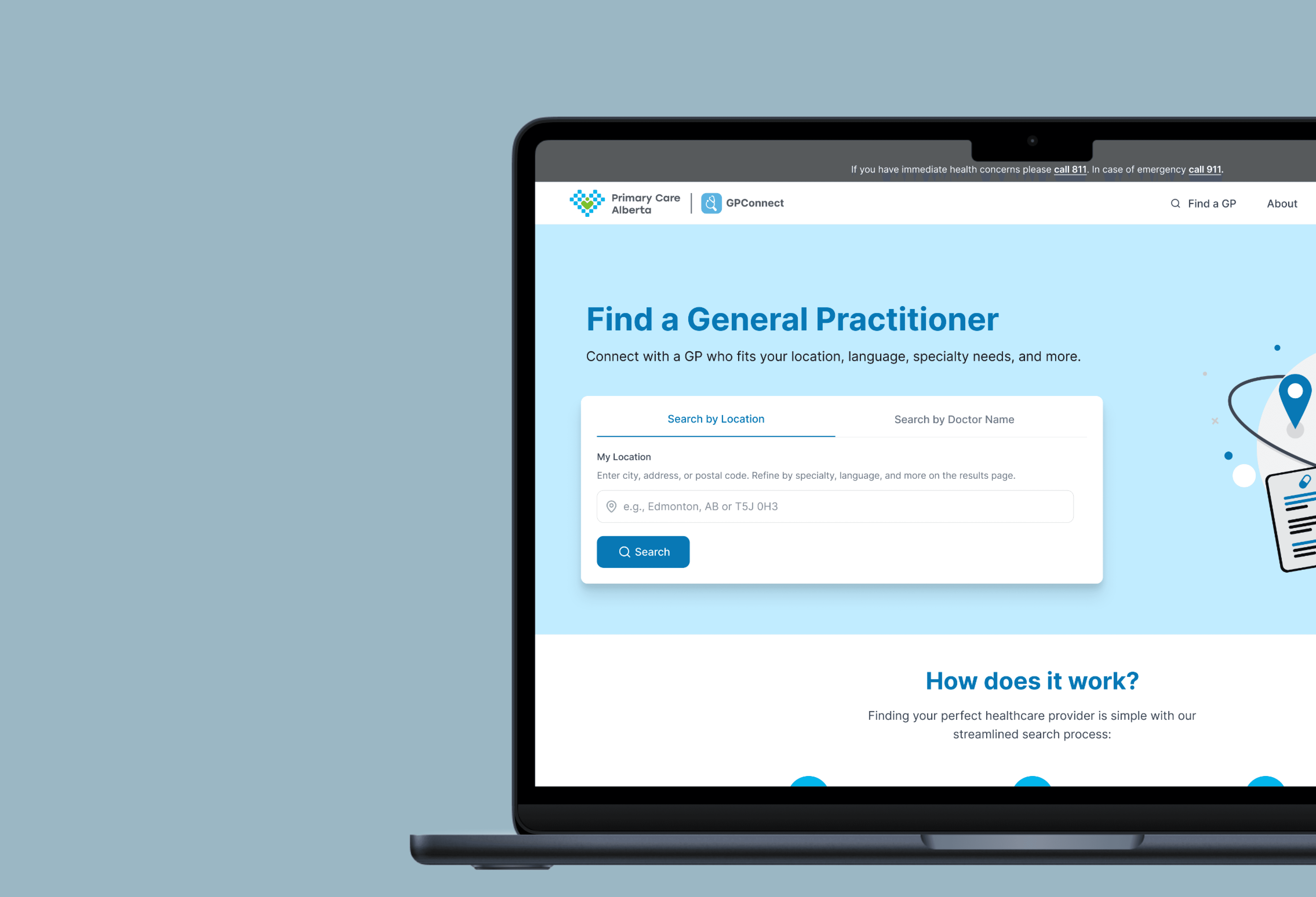
This group project involved in-depth research into Alberta’s healthcare system and the challenges young adults face when trying to find a general practitioner. The process required us to first start with user research, move onto ideating, constructing wireframes, and then move onto our prototype solution – resulting in GPConnect, a redesigned provider discovery tool built within the Primary Care Alberta ecosystem. I contributed to the project by conducting one user interview, developing wireframes and components, and helping create the final prototype.
This group project involved in-depth research into Alberta’s healthcare system and the challenges young adults face when trying to find a general practitioner. The process required us to first start with user research, move onto ideating, constructing wireframes, and then move onto our prototype solution – resulting in GPConnect, a redesigned provider discovery tool built within the Primary Care Alberta ecosystem. I contributed to the project by conducting one user interview, developing wireframes and components, and helping create the final prototype.
2026
2026
Timeline
Tools Used
Figma Adobe Illustrator Taguette
Figma Adobe Illustrator Taguette
Role
UX/UI Designer
UX/UI Designer
CONTEXT
CONTEXT
Four Phases to Completion
Finding a GP in Alberta is a fragmented and frustrating experience, especially for young adults transitioning into adulthood. Existing tools like the Primary Care Alberta “Find a Provider” directory are functional but bare-bones, while private alternatives like ZocDoc don’t serve the Canadian public healthcare context. For Instance, Canadians aged 18 – 34 are nearly 20% less likely to have a regular healthcare provider than those 65 and older.
Finding a GP in Alberta is a fragmented and frustrating experience, especially for young adults transitioning into adulthood. Existing tools like the Primary Care Alberta “Find a Provider” directory are functional but bare-bones, while private alternatives like ZocDoc don’t serve the Canadian public healthcare context. For Instance, Canadians aged 18 – 34 are nearly 20% less likely to have a regular healthcare provider than those 65 and older.
The problem
The problem
Young adults in Alberta lack a centralized, user-friendly way to find a GP that fits their personal needs – leaving them to resort to phone calls, word of mouth, and trial-and-error across multiple disconnected platforms.
Young adults in Alberta lack a centralized, user-friendly way to find a GP that fits their personal needs – leaving them to resort to phone calls, word of mouth, and trial-and-error across multiple disconnected platforms.
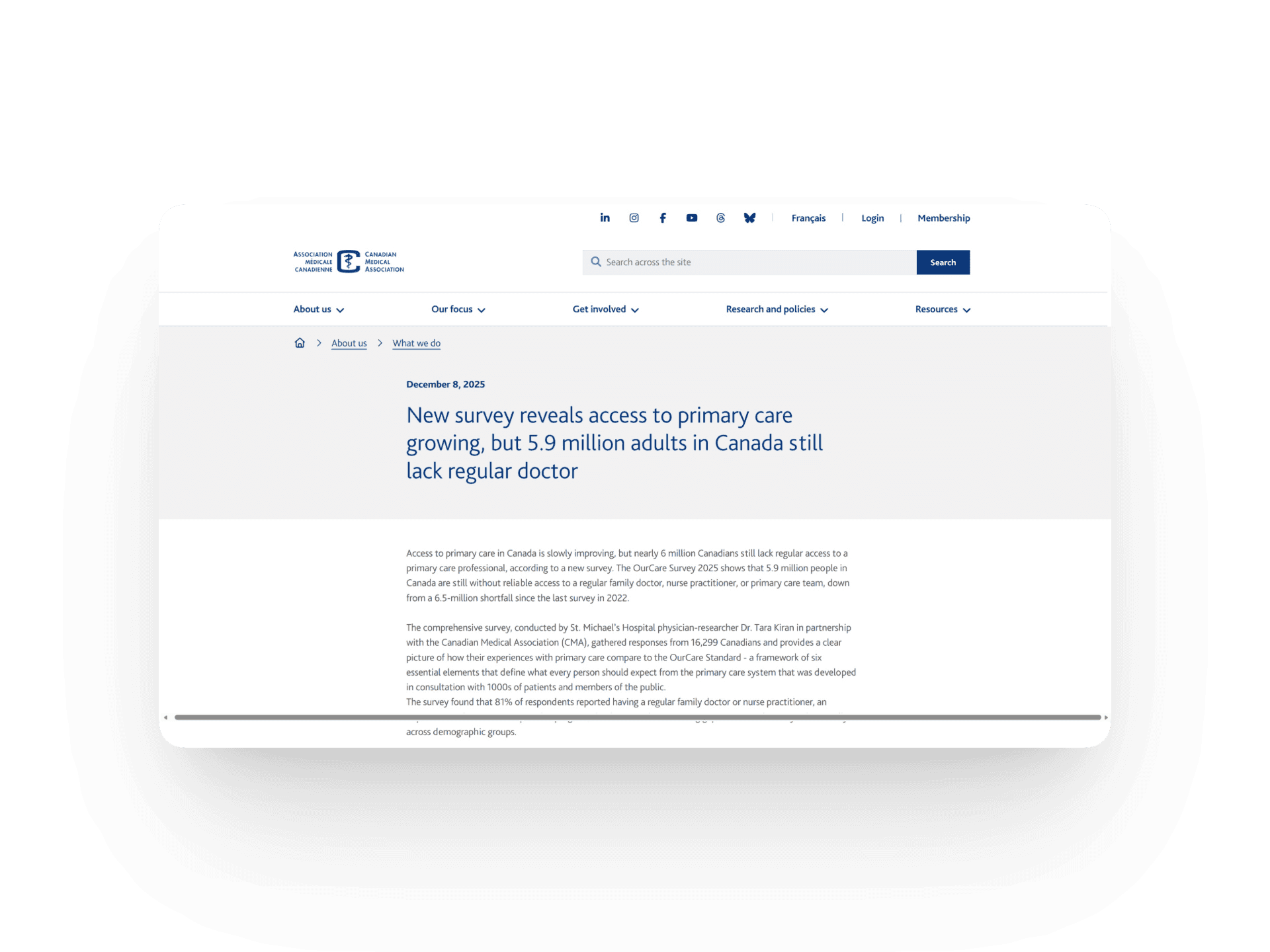
"5.9 million people in Canada are still without reliable access to a regular family doctor, nurse practitioner, or primary care team, down from a 6.5-million shortfall since the last survey in 2022.”
"5.9 million people in Canada are still without reliable access to a regular family doctor, nurse practitioner, or primary care team, down from a 6.5-million shortfall since the last survey in 2022.”
"5.9 million people in Canada are still without reliable access to a regular family doctor, nurse practitioner, or primary care team, down from a 6.5-million shortfall since the last survey in 2022.”
(Canadian Medical Association, 2025)
(Canadian Medical Association, 2025)
(Canadian Medical Association, 2025)
our design challenge
our design challenge
How might we help young adults find a long-term general practitioner that fits their needs?
How might we help young adults find a long-term general practitioner that fits their needs?
secondary research
secondary research
Research that shaped the solution
The team discovered secondary research drawing on Statistics Canada, the Canadian Institute for Health Information and reports from the Competition Bureau.
Our research goals included the following:
The team discovered secondary research drawing on Statistics Canada, the Canadian Institute for Health Information and reports from the Competition Bureau.
Our research goals included the following:
1.
Understand the current landscape of general practitioner (GP) directory websites
Understand the current landscape of general practitioner (GP) directory websites
2.
Find out what information patients look for when selecting a GP
Find out what information patients look for when selecting a GP
3.
How patients book their first appointment with a new GP
How patients book their first appointment with a new GP
constraints
constraints
constraints
Key challenges we encountered
The following three points shaped some of the most important decisions of the project. Each required the team to weigh competing priorities, challenge early assumptions, and land on a direction that best served both the user and the broader healthcare context:
Deciding how to organize results: An early design debate was whether to sort results by clinic or by GP. Since the goal was helping users find a long-term personal relationship with a doctor, the team landed on sorting by GP.
Choosing public vs. private: The team had to weigh the design freedom of building GPConnect as a standalone private product against the trust and verified data that came with keeping it within Primary Care Alberta's existing infrastructure.
Awareness gaps around GP access options: Research revealed that many users were unaware that GPs could offer virtual appointments, phone consultations, and secure messaging. Communicating this clearly in the design without overwhelming users was a key UX challenge.
The following three points shaped some of the most important decisions of the project. Each required the team to weigh competing priorities, challenge early assumptions, and land on a direction that best served both the user and the broader healthcare context:
Deciding how to organize results: An early design debate was whether to sort results by clinic or by GP. Since the goal was helping users find a long-term personal relationship with a doctor, the team landed on sorting by GP.
Choosing public vs. private: The team had to weigh the design freedom of building GPConnect as a standalone private product against the trust and verified data that came with keeping it within Primary Care Alberta's existing infrastructure.
Awareness gaps around GP access options: Research revealed that many users were unaware that GPs could offer virtual appointments, phone consultations, and secure messaging. Communicating this clearly in the design without overwhelming users was a key UX challenge.
The following three points shaped some of the most important decisions of the project. Each required the team to weigh competing priorities, challenge early assumptions, and land on a direction that best served both the user and the broader healthcare context:
Deciding how to organize results: An early design debate was whether to sort results by clinic or by GP. Since the goal was helping users find a long-term personal relationship with a doctor, the team landed on sorting by GP.
Choosing public vs. private: The team had to weigh the design freedom of building GPConnect as a standalone private product against the trust and verified data that came with keeping it within Primary Care Alberta's existing infrastructure.
Awareness gaps around GP access options: Research revealed that many users were unaware that GPs could offer virtual appointments, phone consultations, and secure messaging. Communicating this clearly in the design without overwhelming users was a key UX challenge.
competitor analysis
competitor analysis
competitor analysis
Who we compared:
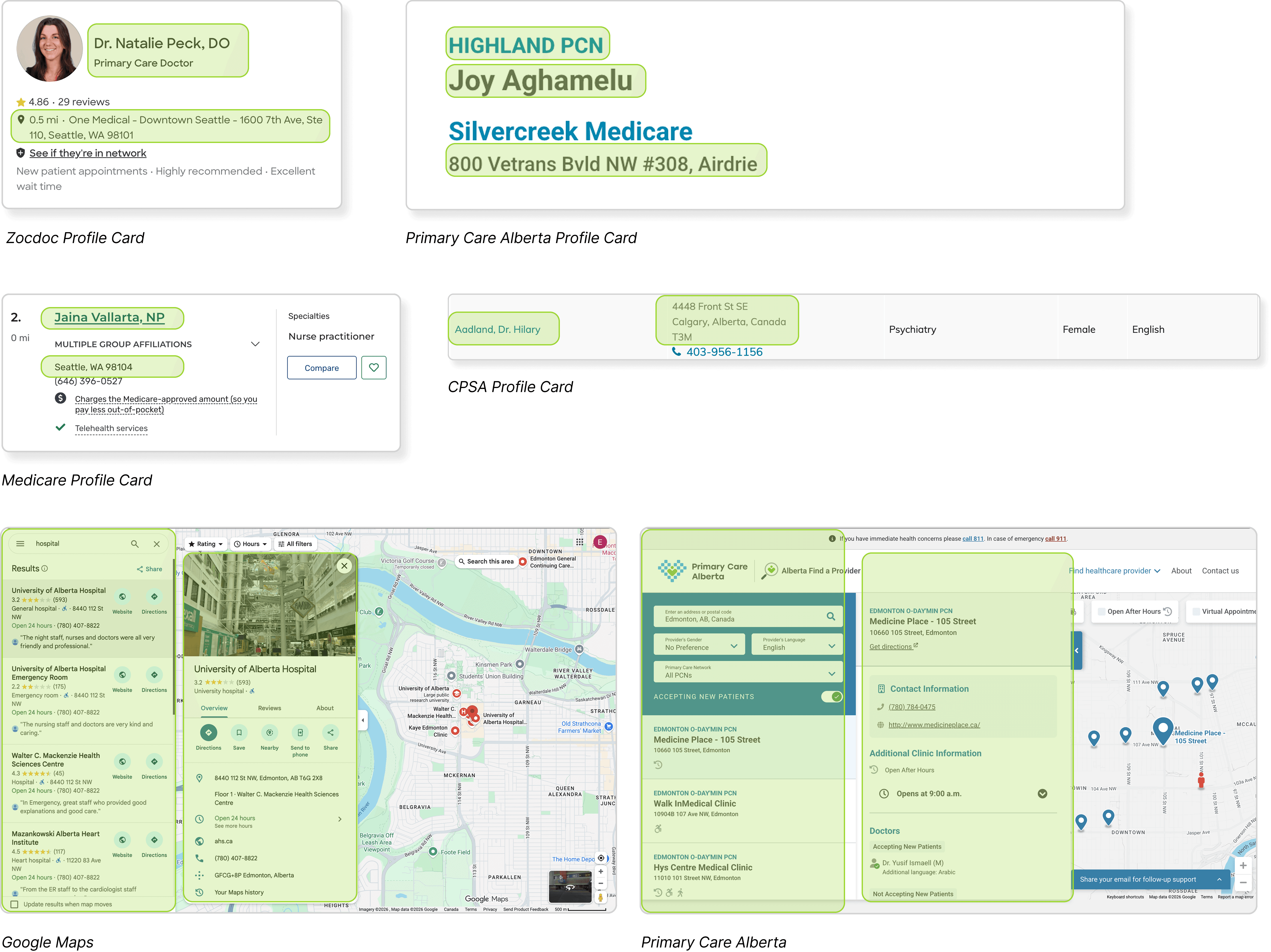
A competitor analysis was conducted on Zocdoc, the College of Physicians & Surgeons of Alberta (CPSA), and Primary Care Alberta to identify key similarities and differences across each platform. This process also highlighted usability issues and pain points within their websites, helping to uncover gaps and opportunities for improvement in the user experience.
user interviews
user interviews
user interviews
Understanding the GP Search Experience
Understanding the GP Search Experience
Six semi-structured interviews were conducted with participants in their early-to-mid 20s, including those who had recently found a GP and those still searching. From these, participants were grouped by key priorities, revealing five insights:
Users prefer phone calls for first appointments for real-time information
Word of mouth is the most trusted way to find a GP
Users value long-term relationships with their GP
Many are unaware of options like virtual or phone consultations
Location and availability are the top decision factors
These insights informed distinct user groups, highlighting key differences in needs, behaviours, and access to primary care, and guiding key design opportunities:
Six semi-structured interviews were conducted with participants in their early-to-mid 20s, including those who had recently found a GP and those still searching. From these, participants were grouped by key priorities, revealing five insights:
Users prefer phone calls for first appointments for real-time information
Word of mouth is the most trusted way to find a GP
Users value long-term relationships with their GP
Many are unaware of options like virtual or phone consultations
Location and availability are the top decision factors
These insights informed distinct user groups, highlighting key differences in needs, behaviours, and access to primary care, and guiding key design opportunities:
Six semi-structured interviews were conducted with participants in their early-to-mid 20s, including those who had recently found a GP and those still searching. From these, participants were grouped by key priorities, revealing five insights:
Users prefer phone calls for first appointments for real-time information
Word of mouth is the most trusted way to find a GP
Users value long-term relationships with their GP
Many are unaware of options like virtual or phone consultations
Location and availability are the top decision factors
These insights informed distinct user groups, highlighting key differences in needs, behaviours, and access to primary care, and guiding key design opportunities:
Newcomers to Canada
Priorities included: Language, Quality of Care, Cultural Sensitivities, Easy access
Young Adults
Priorities included: Location, Reviews, Referrals, Hours, Gender, Specialties
Caregivers
Priorities included: Accessibility, Language, Reviews, Specialties, Quality of Care
design process
design process
design process
Four Phases to Completion
Four Phases to Completion
Four Phases to Completion
The team moved through four phases – Research & Discovery, Ideation, Wireframes, and Solution.
During ideation, group sketches helped define the page structure, followed by more refined wireframes to further develop layout, hierarchy, and interactions. Results were organized by GP rather than clinic to support long-term relationships, and filters were embedded within the results page (aligned with Nielsen Norman Group guidance against advanced search on homepages). GPConnect was then positioned within Primary Care Alberta to leverage an existing trusted platform.
The team moved through four phases – Research & Discovery, Ideation, Wireframes, and Solution.
During ideation, group sketches helped define the page structure, followed by more refined wireframes to further develop layout, hierarchy, and interactions. Results were organized by GP rather than clinic to support long-term relationships, and filters were embedded within the results page (aligned with Nielsen Norman Group guidance against advanced search on homepages). GPConnect was then positioned within Primary Care Alberta to leverage an existing trusted platform.
The team moved through four phases – Research & Discovery, Ideation, Wireframes, and Solution.
During ideation, group sketches helped define the page structure, followed by more refined wireframes to further develop layout, hierarchy, and interactions. Results were organized by GP rather than clinic to support long-term relationships, and filters were embedded within the results page (aligned with Nielsen Norman Group guidance against advanced search on homepages). GPConnect was then positioned within Primary Care Alberta to leverage an existing trusted platform.
Shortened overview of our proposed user flow:
Shortened overview of our proposed user flow:
Search (doctor or location name)
filtered results
GP Profile
Booking (by phone or online)
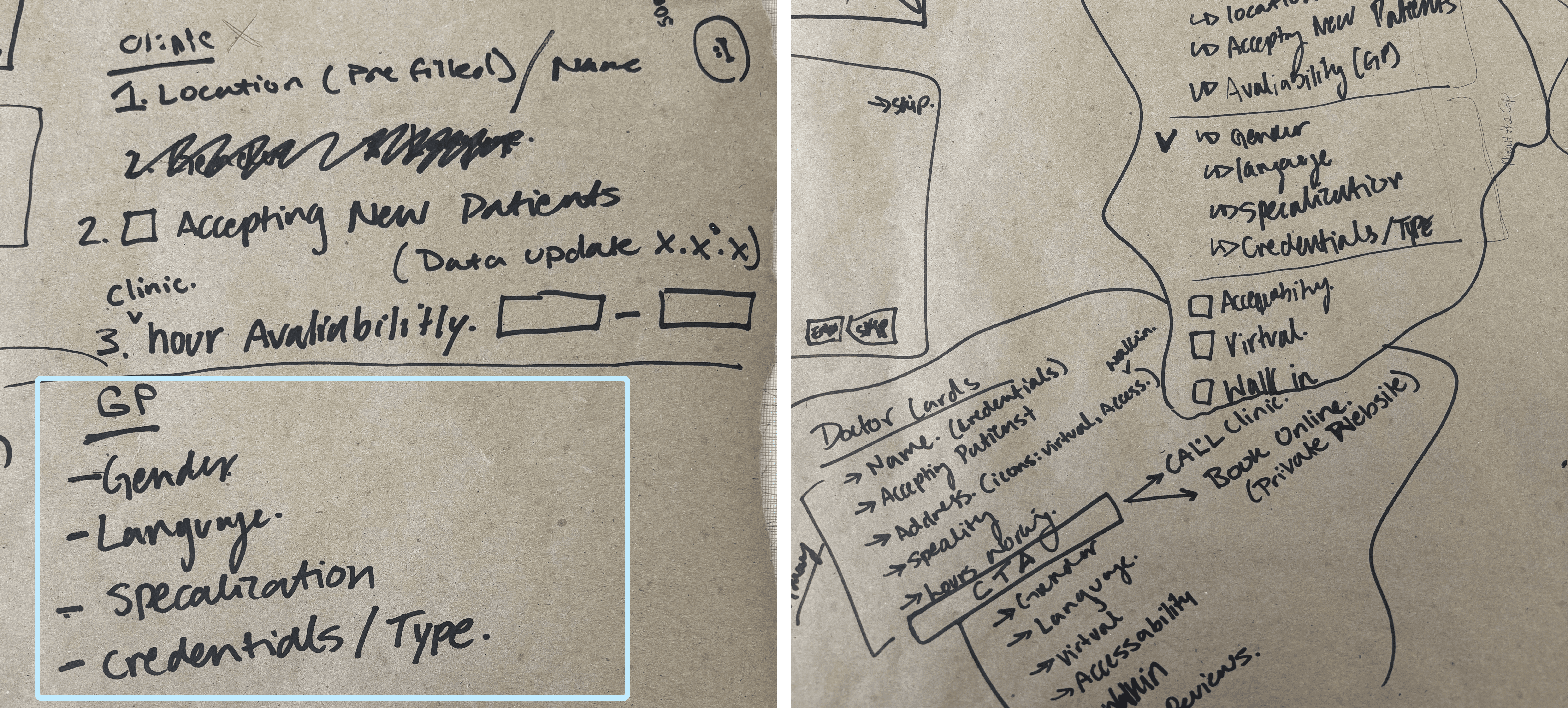
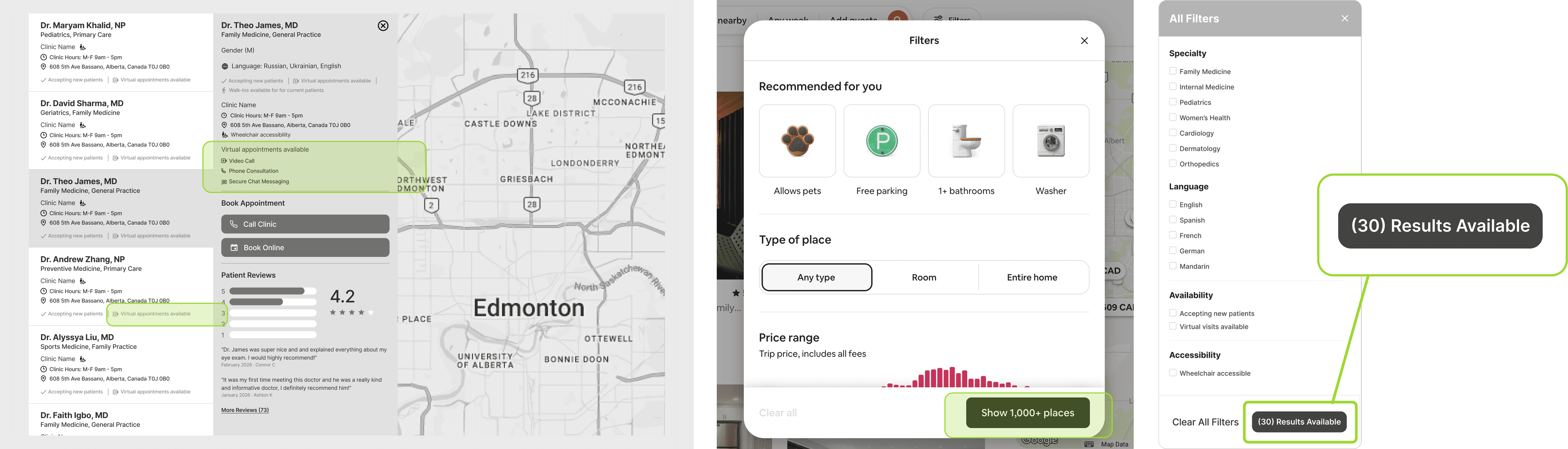
Our wireframes and filters were based on research insights, including proximity, availability, gender, language, specialization, accommodations, and virtual care. The filter panel solution, inspired by Airbnb, dynamically updated result counts to set expectations and reduce drop-off in the final design.
Our wireframes and filters were based on research insights, including proximity, availability, gender, language, specialization, accommodations, and virtual care. The filter panel solution, inspired by Airbnb, dynamically updated result counts to set expectations and reduce drop-off in the final design.
Our wireframes and filters were based on research insights, including proximity, availability, gender, language, specialization, accommodations, and virtual care. The filter panel solution, inspired by Airbnb, dynamically updated result counts to set expectations and reduce drop-off in the final design.
Introducing
Introducing
prototype
prototype
Our Solution
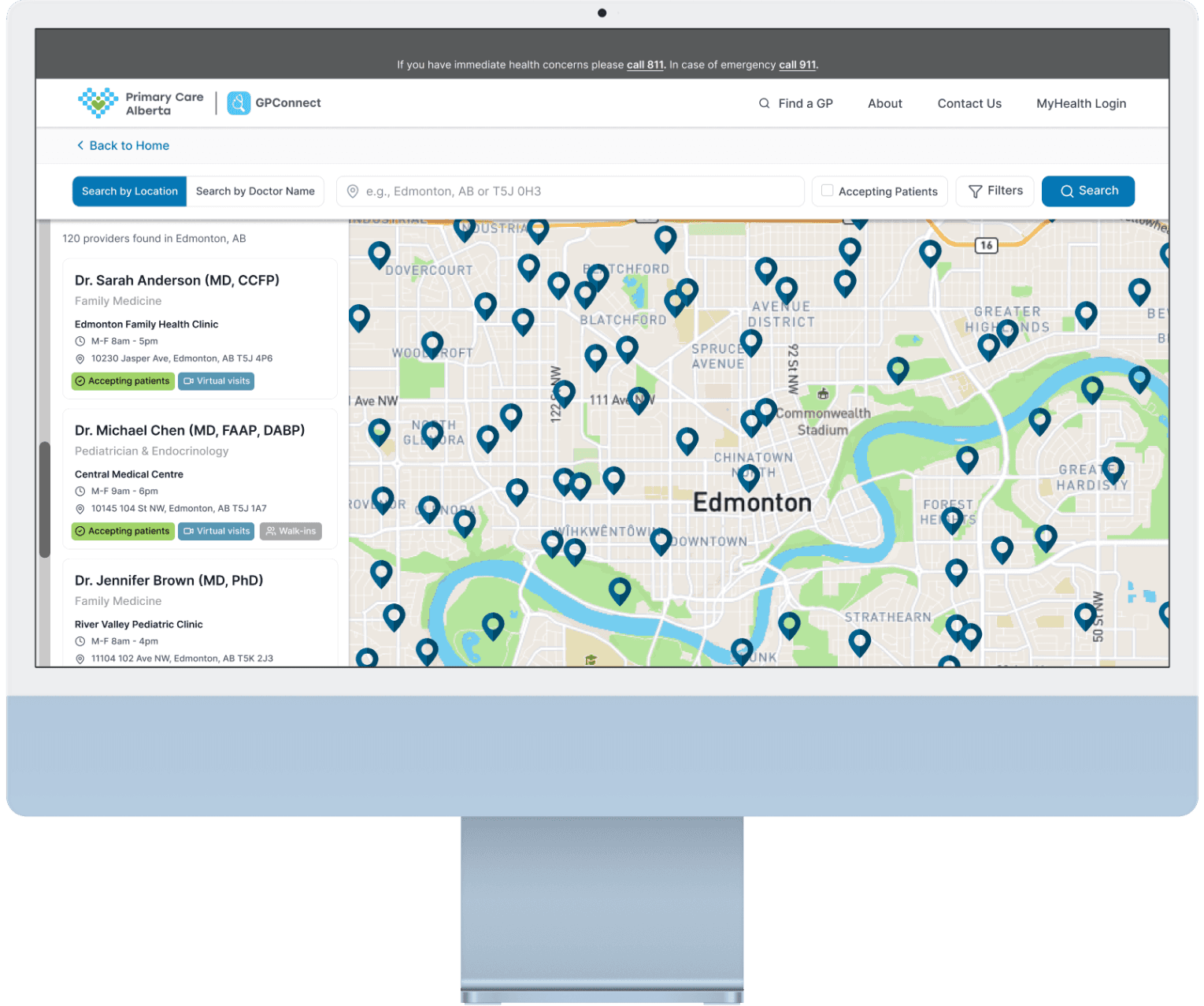
The final design has a clean look consistent with Primary Care Alberta’s branding: a light blue and white palette with green accents for interactive elements. The dual-logo treatment signals both institutional credibility and a purpose-built tool. Typography is clear and accessible, and the layout prioritizes scannable GP cards displaying key information upfront. Users can search by location or doctor name, view results as GP cards alongside a map sorted by proximity, and refine results using quick filters or a full filter panel. Selecting a GP reveals a detailed profile with credentials, availability, and booking options, allowing users to call directly or book online through the clinic or our integrated system (through the inquire through email button).
The final design has a clean look consistent with Primary Care Alberta’s branding: a light blue and white palette with green accents for interactive elements. The dual-logo treatment signals both institutional credibility and a purpose-built tool. Typography is clear and accessible, and the layout prioritizes scannable GP cards displaying key information upfront. Users can search by location or doctor name, view results as GP cards alongside a map sorted by proximity, and refine results using quick filters or a full filter panel. Selecting a GP reveals a detailed profile with credentials, availability, and booking options, allowing users to call directly or book online through the clinic or our integrated system (through the inquire through email button).